[ad_1]
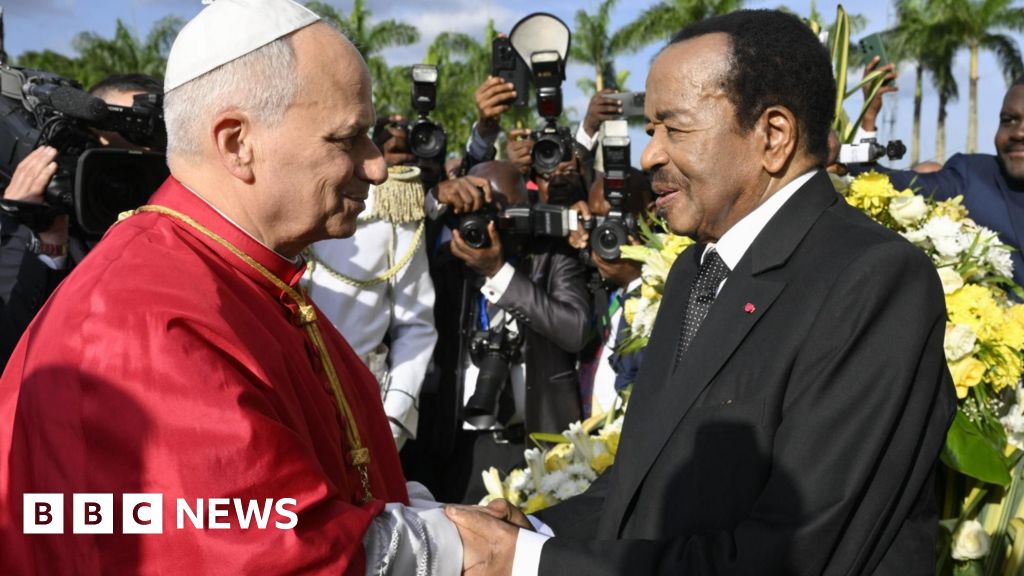
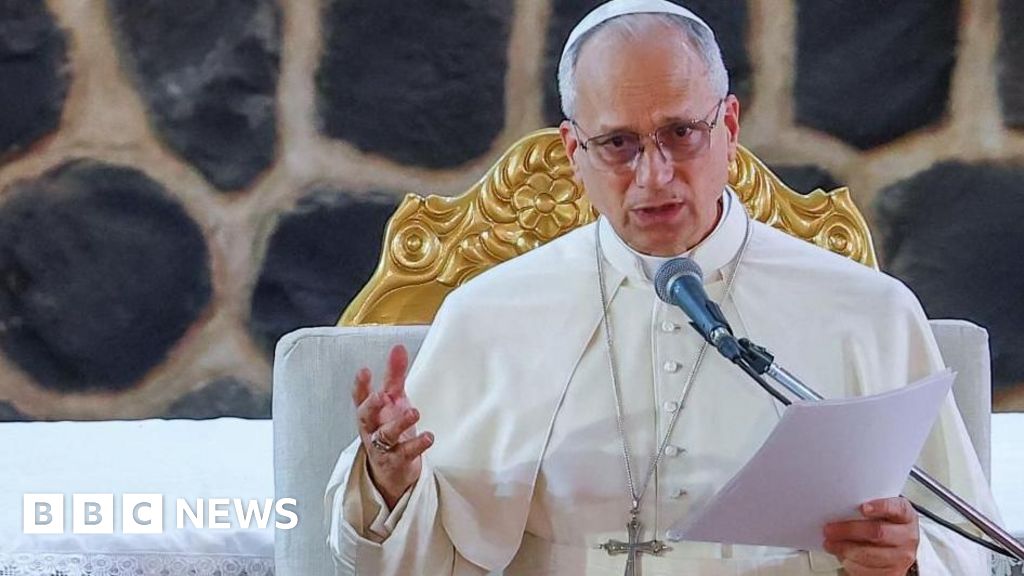
The comments follow a high-profile spat with US President Donald Trump, who called the Pope weak on crime.
The article reports that Pope Leo XIV used a public address to sharply criticize “tyrants” who, in his view, drive or profit from war while appearing to justify their actions through political power and religious rhetoric. The remarks are framed as part of a broader moral indictment of militarism: the Pope argued that a small number of leaders are willing to spend vast sums on conflict, leaving ordinary people to endure the human cost—death, displacement, hunger, and long-term devastation.
A key element of the speech, as described in the article, is the Pope’s use of strong language aimed at leaders rather than nations. Instead of directing blame at soldiers or civilians, he focused on those who hold authority and make decisions that escalate violence. The article emphasizes that the Pope portrayed this authority as corrupt or abusive—hence his use of the term “tyrant”—because it enables destructive policy choices while shielding decision-makers from the consequences. By highlighting the scale of spending on wars—“billions” in the article’s wording—the Pope was also making an implicit argument about how conflict is sustained by institutions, budgets, and political incentives, not only by battlefield events.
The article also notes that Pope Leo XIV connected his critique to a concern about religious manipulation. In his address, he reportedly condemned the misuse of faith as a tool for political aims—particularly the invocation of God or religious language to legitimize violence or military advantage. This is presented as a recurring problem the Pope believes Christians and other religious communities must resist: leaders who claim divine approval to pursue power. The article suggests the Pope viewed this as not merely hypocrisy, but a serious moral failure that harms both believers and victims. In his framing, the “very name of God” becomes a kind of weapon when used to sanctify suffering and justify aggression.
An additional contextual element in the article is the timing of the Pope’s remarks. It states that the Pope’s comments came after a public spat with U.S. President Donald Trump. This part of the report is less about the content of the speech itself and more about the political narrative surrounding it. The article implies that the Pope’s broader statements on war and violence have become part of an ongoing public disagreement with powerful political figures, including Trump. By bringing the “Trump spat” into the story, the article underscores how religious commentary is increasingly entangled with high-profile political conflict. In other words, the Pope’s speech is not portrayed as a neutral moral lesson delivered in isolation; it is presented as occurring during a period of heightened controversy.
The article implies that Pope Leo XIV’s position on war is part of a longer pattern: he calls on leaders to prioritize peace, protect civilians, and reject the idea that military force is automatically justified. However, the report also suggests that his rhetoric—especially the sharp labeling of leaders as “tyrants”—makes his message particularly likely to provoke reaction. That is, because he chooses confrontational language and targets wrongdoing as a moral issue, his words can be read as direct criticism of identifiable governments or leaders rather than as vague calls for restraint.
In explaining why the Pope’s comments landed as they did, the article likely describes the broader international context of conflict and diplomacy—conflicts that have involved major powers and complex alliances, where economic and political interests are intertwined with military action. The article’s “billions” framing points to the idea that modern wars are not only fought with weapons, but with funding, contracts, technology, and infrastructure. The Pope’s moral argument therefore becomes, in the article’s telling, an indictment of the systems that enable war to continue: those who fund and authorize conflict are, in his view, choosing devastation while pretending it is necessary or righteous.
The piece also highlights the Pope’s concern about the “endless cycle” of violence—an idea that conflicts do not end neatly with ceasefires or negotiations, but can be renewed or intensified by retaliation, propaganda, and revenge. The article presents this as a central theme: war is not treated as an exceptional event but as a repeating pattern that becomes normal. In that sense, the Pope’s critique is aimed not only at specific acts of war, but at the political logic that makes war seem permanent. He reportedly argued that this cycle destroys families and communities while failing to resolve underlying grievances.
Another point in the article is that the Pope’s critique extends beyond battlefield actions to the moral responsibility of those who influence decisions. The article suggests the Pope sees tyrannical leaders as people who can afford the costs of war but are unwilling to accept its burdens. That imbalance is portrayed as the core moral scandal: decision-makers allocate money and lives as though the consequences are distant, while victims experience the immediate reality of destruction. By focusing on leaders and budgets, the Pope is, according to the report, trying to shift the conversation from sympathy for victims to accountability for power.
The article’s inclusion of the Pope’s religious emphasis matters because it places the speech within a spiritual and ethical framework. Pope Leo XIV is not merely calling for a political solution; he is calling for a moral transformation. In this telling, he implies that faith communities should not be used as instruments of state violence and that religious identity should not be turned into a cover for aggression. The Pope’s remarks are thus presented as both a political statement and a theological warning: when religion is exploited to sanctify war, believers become complicit in wrongdoing, even if they do not intend to be.
As for the “Trump spat,” the article suggests the conflict between the Pope and Trump—and the way it plays out publicly—illustrates a broader trend: high-profile political figures increasingly treat religious commentary as something that must be defended, attacked, or spun. The Pope’s remarks are therefore not only about peace; they are also about the role of moral authority in public life. The article implies that Trump’s reaction (or the broader disagreement) is tied to the Pope’s willingness to critique powerful actors, including those associated with U.S. foreign policy or allied actions. The report uses this to make the Pope’s speech feel timely and politically charged, rather than purely pastoral.
The article may also highlight how the Pope’s choice of words—like “tyrants”—is meant to avoid neutrality. In many international settings, leaders are careful to avoid naming specific individuals or groups. But the Pope’s language, as described, is direct and accusatory. The article frames this as a deliberate rhetorical strategy: it signals that moral accountability matters and that the Pope does not believe the status quo of political leaders ordering violence should be accepted as normal.
Ultimately, the article portrays Pope Leo XIV as continuing to present war as a moral failure rather than a strategic necessity. By condemning leaders who spend vast resources on conflict, and by warning against the manipulation of religion to justify violence, the Pope’s speech in the report becomes an attempt to reassert moral clarity in a period of political noise. The fact that it follows a public dispute with a major U.S. political figure adds drama to the story, reinforcing the theme that moral leadership can provoke backlash, especially when it challenges national interests and the rhetoric of powerful states.
[ad_2]